The Watchers

The Watchers
Showing posts with label classic movies. Show all posts

Thursday, 12 April 2018

Sunset Boulevard (1950)


Currently on tour around the UK is a revival of the stage musical version of Sunset Boulevard. Starring musical theatre star Ria Jones and actor Danny Mac in the lead roles, the musical takes its inspiration from the 1950 black-and-white movie directed by Billy Wilder. 


Sunset Boulevard tells the story of Joe Gillis, a down-on-his-luck screenwriter. While on the run from people who want to repossess his car, Joe finds an old Hollywood mansion and meets a former silent movie actress, Norma Desmond, living in seclusion. But Norma has a plan to make her triumphant return to the screen with a self-penned screenplay about Salome, to be directed by the great Cecil B. DeMille. Flattering his way to becoming Norma's script doctor, the relationship between the older woman and the younger man begins to shift and the path is laid for tragedy...

The film is something of a poisoned Valentine to Hollywood and the movie business, exposing its cynicism and venality, its preference for youth and beauty, and the somewhat shady goings-on behind the scenes. It's also, in my opinion, one of the greatest films ever made, with two superlative performances by Gloria Swanson and William Holden as Norma and Joe.  

In some ways, Swanson's career echoed that of Norma Desmond. Swanson was a big star of the silent era and, at the inaugural Academy Awards in 1929, was one of the first Best Actress nominees (losing out to Janet Gaynor). However, she was one of the many silent stars that didn't make the transition to talkies. But, unlike Norma, Swanson didn't dwell on her glory days: she took to radio, stage, and eventually television work. Prior to Sunset Boulevard, Swanson hadn't appeared on film since 1941 and was initially unsure about auditioning the role but was encouraged by her friend, the film director George Cukor, who told her 'if they want you to do ten screen tests, do ten screen tests. If you don't, I will personally shoot you'. She auditioned... and the rest is movie history. Norma Desmond is an absolute gift of a part and Swanson's incredible performance has left an indelible mark on the cinematic landscape, and also forever tied her to the character. Norma is a woman full of contradictions; flighty, generous, obsessive, forthright. She is a tragic figure but never played as one, not even at the end. Sadly, Sunset Boulevard didn't provide the career renaissance Swanson hoped it would; while she was offered roles after the success of the film, they were almost always pale imitations of Norma Desmond. She eventually retired from film-making and concentrated on television work. She made her final film appearance in Airport 1975. 

However, the film did provide leading man William Holden with a much-needed career boost. After making a big impression with the aptly-named Golden Boy (1939), Holden languished in second-rate romantic comedies until the role of Joe Gillis came his way. Montgomery Clift was originally attached to the role but, due to some personal issues, he quit the production two weeks before filming started. Joe is a gem of a part too; as equally exploited as exploitative, he initially sees Norma as a meal ticket but starts to see her as something more than that. After Sunset Boulevard, Holden's career picked up- he won a Best Actor Oscar for Stalag 17 (1953), and picked up a further nomination for his roles in Network (1976). His filmography also went on to feature such films as The Country Girl (1954), The Bridge On The River Kwai (1957) and The Wild Bunch (1969). 

Erich Von Stroheim was a former director- having directed The Merry Widow (1925), The Wedding March (1928), and Clipped Wings (1933)- who turned to acting, and takes the role of Max Von Mayerling, Norma's butler. Towards the end of the film, it's revealed that Max used to be a film director- and was Norma's first husband. After Norma's career faltered due to the advent of the talkies, Max gave up film-making to look after her. Indeed, when Norma is showing one of her old films, footage from her performance in Queen Kelly (1929) is shown... which was directed by Von Stroheim! Despite being nominated for a Best Supporting Actor Oscar for his performance, Von Stroheim was dismissive of his role, calling it 'that butler role'. The film wouldn't have such an emotional impact without his stoic, dignified turn. 

The last member of the main cast is Nancy Olson, who plays Betty Schaefer, a young script reader at Paramount who initially clashes with Joe over a spec script he'd written. Olson was a relative newcomer- Sunset Boulevard is only her second credited film appearance (after Canadian Pacific in 1949) but she more than holds her own against her more experienced cast-mates. The relationship that develops between Betty and Joe is tender and believable, which makes the events at the end even more poignant. Olson went on to appear opposite Jerry Lewis in The Absent Minded Professor (1961) and Son Of Flubber (1963) and reunited with co-star Swanson in Airport 1975. 

The film also features several cameo appearances by real-life people associated with the movie business. Director Cecil B. DeMille (The Greatest Show On Earth, The Ten Commandments) appears as himself, meeting Norma on the Paramount lot to discuss her Salome film while he was shooting Samson And Delilah (1949). He and Swanson worked together in the late 1910s and early 1920s and DeMille uses his term of endearment for Swanson- 'young fellow'- to Norma. Former silent movie stars H.B. Warner, Anna Q. Nilsson, and Buster Keaton appear as Norma's bridge partners (dubbed 'the waxworks' by Joe), whilst former actress turned gossip columnist Hedda Hopper (memorably played by Helen Mirren in Trumbo and Judy Davis in Feud: Bette And Joan) plays herself at the end, reporting on the tragedy at the house. 

Cecil B. DeMille, Hedda Hopper, Anna Q. Nilsson,
H.B. Warner and Buster Keaton appear as themselves.
The screenplay is particularly quote-worthy with several lines, such as the now-iconic 'I am big; It's the pictures that got small' and the killer final line- 'All right, Mr DeMille, I'm ready for my close-up'- entering the cultural consciousness. There's also some inventive camera-work at play too; the opening shot of the dead body floating in the pool was achieved by shooting the scene through a mirror at the bottom of the water tank which would- from the right angle- be able to show the body in the water, and the police and photographers standing at the pool's edge. In several scenes, cinematographer John F. Seitz sprinkled dust in the air to be caught in the lights to create atmosphere. A lot of the photos of the young Norma that are around the mansion are genuine publicity photos from Gloria Swanson's silent movie career. 

A body is found in the swimming pool... but whose is it?
The film was widely praised by critics when it was first released, and was approved of in some Hollywood circles: after a private screening, Barbara Stanwyck reputedly knelt before Swanson and kissed the hem of her gown. However, not everyone in Hollywood was as pleased as Stanwyck. Studio head Louis B. Mayer told Wilder he should be tarred, feathered, and horse-whipped for bringing the movie business into disrepute. Wilder's response was a terse, two-word one. Former silent movie stars Norma Shearer, Mae Murray, and Mary Pickford (whom Wilder and Brackett initially approached to play Norma, but soon realised their mistake as her discomfort over the story became more and more apparent as they discussed it with her) found the movie offensive. 

Composer Franz Waxman with his Oscar
Sunset Boulevard was nominated for 11 Oscars- including Best Picture, Best Director (Wilder), Best Actor (Holden), Best Actress (Swanson), Best Supporting Actor (Von Stroheim), Best Supporting Actress (Olsen), Best Film Editing, and Best Cinematography- and won three: Best Music, Best Art Direction-Set Decoration, and Best Original Screenplay. This was also the last collaboration between Wilder and longtime screenwriting partner Charles Brackett. To the great surprise of many, Swanson didn't win the Oscar for her performance. She was up against some fierce competition, including the truly stellar performance by Bette Davis in All About Eve. With Davis' co-star Anne Baxter already nominated in the Best Actress category, it was felt this may have split the vote, allowing Swanson to win. However, in the end it was Judy Holliday who won for her role in Born Yesterday. In 1989, Sunset Boulevard was one of the first films to be selected for the Library of Congress' National Film Registry having been deemed 'culturally, historically, or aesthetically significant'. 

The many faces of Norma Desmond
(Top L-R: Patti LuPone, Rita Moreno, Petula Clark, Glenn Close
Bottom L-R: Elaine Paige, Ria Jones, Betty Buckley, Diahann Carroll) 
The stage musical version- with music by Andrew Lloyd Webber, and lyrics by Don Black and Christopher Hampton- made its West End debut in 1993, with a Broadway debut in 1994. The role of Norma Desmond has become a choice role in musical theatre circles- getting two songs ('With One Look' and 'As If We Never Said Goodbye') which have become musical theatre standards- with Oscar-nominated actresses Diahann Caroll and Glenn Close, Oscar-winning actress Rita Moreno, singer Petula Clark, and musical theatre royalty Patti LuPone, Elaine Paige, and Betty Buckley all taking the lead role at various times. There have even been longstanding rumours that a film version of the stage musical will be made, with Glenn Close in talks to reprise her Tony-winning performance. 

But none of that would be possible without the 1950 original. It's a truly brilliant piece of film-making.

Tez

'All right, Mr DeMille, I'm ready for my close-up...'

Monday, 16 October 2017

Cabaret (1972)


Currently on tour of the UK is a revival of the stage musical Cabaret, which had a big screen adaptation made in 1972. 

Based on John Van Druten's 1951 play I Am A Camera- which itself was based on the novella Goodbye To Berlin by Christopher Isherwood- and with music and lyrics by John Kander and Fred Ebb (who also wrote Chicago and Kiss Of The Spider Woman), Cabaret tells the story of a vivacious young showgirl- Sally Bowles- who sings and dances at the Kit Kat Klub, a seedy nightclub in 1930s Berlin. She meets and falls in love with a young writer, but the atmosphere in the city is changing, as the Nazis begin their rise to power. The show opened on Broadway in 1966 with the London premiere happening two years later and featuring Judi Dench in the lead role as Sally Bowles. 

The film was directed by Bob Fosse and starred Liza Minnelli as Sally Bowles, Michael York as Brian Roberts, and Joel Grey as the Master of Ceremonies (reprising his role from the original Broadway production).


Liza Minnelli with director Bob Fosse on set
There are a number of differences between the film and the stage version. In the stage version, Sally is English and the writer (Cliff) is American; in the film, the writer (Brian) is English whilst Sally is American. A major subplot featuring the sweet but ultimately doomed romance between boardinghouse landlady Fraulein Schneider and a Jewish fruit-seller Herr Schultz is removed, although there remains an element of this story in the relationship between Fritz and Natalia. The love triangle element between Sally, Brian and Max doesn't feature in the stage version at all, although subsequent productions have brought Cliff's bisexuality to greater prominence. Several of the musical numbers from the stage show have either been cut or are only heard in instrumental versions.


Sally Bowles is Liza Minnelli's Norman Bates or Ellen Ripley; this is the role that she will be forever twinned with in people's minds. And that's no bad thing. It is a truly iconic role- her introduction at the Kit Kat Klub before she sings 'Mein Herr', in bowler hat and black stockings and suspenders, is a defining moment of 70s cinema, as is her final defiant rendition of the film's title song. Sally is a complicated character; a woman who enjoys 'divine decadence', a vivacious flibbertigibbet, flirtatious, inappropriate, sensuous, yet still having a little-girl-lost quality which stops her being an over-the-top archetype. It may be a cliche but she just wants to be loved. It's an outstanding performance which still impresses, 45 years later. 


 As Sally's love interest Brian, Michael York is a wonderful counterfoil for Minnelli. Brian is quiet, studious, a little shy, like the audience a little taken aback by the force of nature that is Sally Bowles. But he impresses in the quieter moments as their fumbling relationship takes root; Brian's also one of the few people to actively speak up against the Nazis' rise and call people out on their anti-Semitism. Of course, this doesn't get him very far, but it's important to show that not everyone in Berlin was sleepwalking into the arms of the Nazis. 

As the Master of Ceremonies for the Kit Kat Klub, Joel Grey is a consummate all-rounder. From the opening notes of 'Wilkommen', he's your guide to the hedonistic world of the club and its refuge against the real world. A capering, white-faced, rouged puppet, he sings and dances as the clouds begin to gather and keeps the club together. He is never seen outside the Klub and all his musical numbers echo what is happening in the outside world- a Tyrolean hand-slapping dance number is cut between scenes of a man being beaten up, and the truly shocking 'If You Could See Her' with the gut-punch final line of 'she wouldn't look Jewish at all' (sung to a woman in a gorilla suit) comes as a group of Nazi thugs kill Natalia's dog. 

As goes the other cast members, Helmut Griem is charming as rich playboy Maximilian von Heune, with whom both Sally and Brian have a relationship, whilst Fritz Wepper and Marisa Berenson are both similarly lovely in their supporting roles of Fritz and Natalia. Fritz is passing as a Christian, although is Jewish, whilst Natalia is Jewish; their relationship is quite endearing as Fritz must decide whether to 'out' himself as Jewish in order to marry the woman he loves (no mean feat given the atmosphere of the time). 

The film's treatment of the Nazis is interesting. At the beginning, a Nazi is thrown out of the Kit Kat Klub; their rhetoric is not accepted there. However, the growing tide of the party starts to come to the fore, culminating in a scene in a beer garden where the patriotic song 'Tomorrow Belongs To Me' is sung by a young man who is revealed to be wearing a Hitler Youth uniform. As the other patrons start to join in, Brian looks uncomfortable. After this, a can-can routine at the Klub turns into a goose-step (although it's not clear whether this is mockery or not) and Brian gets beaten up after opposing Nazis in the street. At the very end of the film, a shot of the club shows men in Nazi uniforms sitting in the audience.


Visually, the film is really interesting and there's a nice contrast in both style and camera-work between the club and the real world. And also, whilst this is a musical, all of the musical numbers- bar 'Tomorrow Belongs To Me'- take place in the Klub; Sally doesn't suddenly burst into song whilst in bed with Brian. Of the musical numbers, Minnelli gets the lion's share of the good ones- with 'Mein Herr', the beautifully poignant 'Maybe This Time' and the title song 'Cabaret' becoming well known. Grey doesn't get short-changed, however, with the wicked 'Two Ladies', the magnificent duet 'Money, Money' with Minnelli, and the opening number 'Wilkommen'. 


Cabaret holds the record for the most Oscars won by a film which didn't win Best Picture. Nominated for ten Academy Awards, it won eight; Minnelli and Grey won Best Actress and Best Supporting Actor respectively, and the film was also honoured for its cinematography, art direction, sound, and editing. But perhaps the biggest surprise on the night was Fosse winning Best Director (over Francis Ford Coppola for The Godfather, which went on to win Best Picture). 

The film also won the Golden Globe and BAFTA Film Award for Best Film, with Minnelli and Grey also winning those awards for their performances. In 1995, Cabaret was also selected by the Library of Congress as one of twenty-five films to be entered into the National Film Registry that year as a work that is 'culturally, historically, or aesthetically significant'. It's also seen as a landmark film in LGBT cinema as it deals with themes of sexuality in an unusually frank and non-sensational (and non-judgemental) way. 


Liza Minnelli and Joel Grey with their Oscars at the 1973 ceremony
Cabaret is a musical with a difference; it's certainly no Sound Of Music. There's no happy ending here, and there's no attempt to soften or lighten some of the more dark material. It was the first musical ever to be given an X rating (although now it's a 15 certificate in the UK). So, if you think all musicals are trite and twee and everyone lives happily ever after, Cabaret gives the lie to that. Perhaps take Sally's advice and 'come to the cabaret'. It's an experience you won't forget in a hurry.

Tez


'Life is a cabaret, old chum. Come to the cabaret!'

Tuesday, 18 July 2017

The Graduate (1967)


On tour around the UK at the moment is a stage version of The Graduate. The film itself celebrates its golden anniversary this year, so it seems timely to take a look back at the film. 

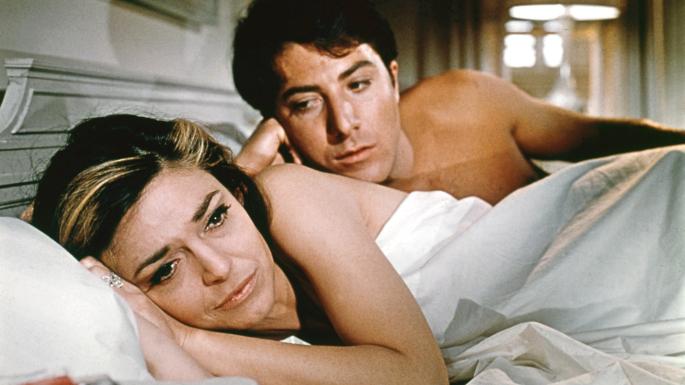
Based on the 1963 novella of the same name by Charles Webb, it's the story of Benjamin Braddock, a young man who has just finished college and is looking for a direction in life. Into his life comes Mrs. Robinson, an older woman who is the bored and neglected wife of one of Benjamin's father's work colleagues. Despite the age difference- she is twice as old as him- Benjamin and Mrs. Robinson start an affair. However things become complicated when it is suggested that Benjamin dates Mrs. Robinson's daughter Elaine.

Working from a script by Calder Willingham and Buck Henry, The Graduate was director Mike Nichols' second feature film (his first was the searing Who's Afraid Of Virginia Woolf?). The cast- featuring Dustin Hoffman and Anne Bancroft- have become indelibly linked with these characters, although the end result could have been quite different. 


The Graduate is Dustin Hoffman's second film role and he's great as the nebbishy unfocused Benjamin, literally drifting through his life. Apparently, Hoffman's audition didn't go very well; one of the producers thought he was a messenger boy! He was asked to perform a love scene with Katharine Ross (who plays Elaine Robinson) but had never done one before, and later said 'a girl like her would never go for a guy like me in a million years.' Despite this disastrous start, Nichols saw something in the performance that convinced him Hoffman was right for the part. Warren Beatty and Robert Redford were among the top choices for the role of Benjamin, although Beatty turned the film down due to his filming commitments with Bonnie And Clyde (and that's not the only time you'll hear that particular reason for someone not being cast). Nichols felt that Redford didn't possess the underdog quality he was looking for in Benjamin; when Nichols asked Redford had he ever 'struck out with a girl', Redford responded 'what do you mean?' (let's face it, Redford- with his stereotypical movie-star looks- could have had his pick of women). Robert Duvall, Steve McQueen, Harrison Ford, Jack Nicholson, Anthony Perkins, Gene Wilder, Albert Finney and Brandon DeWilde were all considered, whilst Charles Grodin turned the role down due to financial considerations, and Burt Ward (then playing Robin in the Batman TV series) had to pass due to his filming commitments. 

As the sultry Mrs. Robinson, Anne Bancroft absolutely shines. You do have to wonder how much Bancroft's amazing performance led to the fact that 'Mrs. Robinson' has now passed into common lexicon for an older woman who is involved with a younger man (and it's so much nicer a term than 'cougar'). Bancroft plays Mrs. Robinson as a woman angry with herself for giving up on her own passions and desires (her interest in art, for instance) to marry a man who is wealthy and will provide security. Sure, she has the trappings of wealth- but she's lonely, bored and aching to be loved. It's only at the end that she becomes a villain, forcing Elaine into marriage, but it's a beautifully nuanced performance throughout. And despite the age difference in the script (Mrs. Robinson is meant to be in her mid-forties with Benjamin turning 21 shortly), Bancroft was 36 and Hoffman was 29 at the time of filming! Rumours persist that Doris Day was Nichols' original choice for Mrs. Robinson- she was approached but turned the role down due to the nudity involved. Nichols' actual first choice was the French actress Jeanne Moreau (as, in French culture, it is often an older woman who 'train' younger men in matters of sex) but the producers baulked at this idea. A veritable Who's Who of 1960s Hollywood were either considered or expressed interest in the role- Joan Crawford, Geraldine Page, Patricia Neal, Grayson Hall,  Lauren Bacall, Lana Turner, Anne Baxter, Shelley Winters, Rita Hayworth, Sophia Loren, Angela Lansbury, Simone Signoret, and Audrey Hepburn all enquired about or were considered for the role. Ava Gardner reportedly petitioned for the role and met with Nichols in her hotel room, only to tell him 'first of all, I strip for nobody!'


Whilst Bancroft and Hoffman get the lion's share of the attention, it means that Katharine Ross' lovely supporting turn as Elaine gets overlooked- and that is a shame. By turns vulnerable, confused, torn, forthright and determined, Elaine becomes more than a match for Benjamin- much to her mother's disapproval. Aside from Ross, there were several actresses considered: Sally Field, Shirley MacLaine, Natalie Wood and Patty Duke all turned the role down as did Faye Dunaway (due to her commitments with Bonnie And Clyde). Candice Bergen screentested for the role (opposite Robert Redford), as did Jane Fonda and Goldie Hawn, whilst Ann-Margret, Suzanne Pleshette, Hayley Mills, Lee Remick, Julie Christie, and Tuesday Weld were all considered before Ross was cast.

In the role of Mr. Robinson, Gene Hackman was originally cast but replaced just before filming began as it was felt he was too young; this meant he could take a role in Bonnie And Clyde (which garnered him his first Oscar nomination) instead. Marlon Brando, Gregory Peck, George Peppard, Jack Palance, Frank Sinatra, and Walter Matthau were all considered before Murray Hamilton was cast. For Benjamin's parents, Susan Hayward was considered for Mrs. Braddock but the role was given to Elizabeth Wilson; whilst Yul Brynner, Kirk Douglas, Jack Lemmon, Robert Mitchum, Karl Malden, Christopher Plummer and Ronald Reagan were considered for Mr. Braddock, with the role going to William Daniels. 

One of the many iconic things about the film is the soundtrack which utilises several songs from Simon & Garfunkel, including the mournful 'The Sound Of Silence' and the exuberant 'Mrs. Robinson' (changed from Simon's original 'Mrs. Roosevelt'). Initially, 'The Sound Of Silence' was only used as a pacing device for the edit before Nichols realised that it worked really well and captured the mood he was after. The soundtrack album reached the top of the charts in 1968.


Leslie Caron presenting Mike Nichols with his Oscar
The film was lauded at the 1968 awards season. Despite being nominated for seven Oscars (including Best Picture, Best Adapted Screenplay, Best Cinematography, Best Actor for Hoffman, Best Actress for Bancroft, and Best Supporting Actress for Ross) it won one- Mike Nichols for Best Director. Nichols also won the Golden Globe, the BAFTA, and the Directors' Guild Award. To date, it is the only film to win Best Director and no other award. The film won the Golden Globe for Best Picture- Musical or Comedy (although I take issue that it can be considered a comedy; for me, it's much more of a drama) and the BAFTA for Best Film. Willingham and Henry's script won the Writers' Guild Award and the BAFTA, whilst also being nominated for the Golden Globe. Hoffman won both the Golden Globe and the BAFTA for Most Promising Newcomer (and was nominated for the Best Actor- Musical or Comedy Golden Globe) whilst Bancroft won the Best Actress- Musical or Comedy Golden Globe and was nominated for the Best Actress BAFTA, and Ross won the Most Promising Newcomer Golden Globe and was nominated for the same award at the BAFTAs. The soundtrack also won a Grammy. 

In 1996, The Graduate was selected for preservation in the Library of Congress as part of the National Film Registry. This honour is given to 'culturally, historically, or aesthetically significant films' and The Graduate is indeed culturally and historically significant. Cinema in the 1960s started to look at more social and societal issues. Alongside The Graduate at the 1968 Oscars, the other Best Picture nominees featured Bonnie And Clyde, Guess Who's Coming To Dinner and In The Heat Of The Night (the eventual winner)- films that look at issues of race and gender and American society at large. The other film was Doctor Doolittle, which shows there's still always space for cosy escapism.

If you've never seen The Graduate, it's definitely worth a look. A great soundtrack, superb performances and expertly directed. Here's to you, Mrs. Robinson!


Wednesday, 7 June 2017

Murder On The Orient Express (1974)


Last week, the first trailer for the new version of Murder On The Orient Express was released. Directed by and starring Kenneth Branagh as Hercule Poirot, the cast also includes Michelle Pfeiffer, Judi Dench, Penelope Cruz, Willem Dafoe, and Johnny Depp. 

However, it is not the first film adaptation of Agatha Christie's novel. There was a version released in 1974, directed by Sidney Lumet, which was the first of the all-star Christie adaptations of the 1970s and 1980s.

December 1935. The famed Belgian detective Hercule Poirot is travelling from Istanbul to England aboard the Orient Express. He is berthed in the Calais coach and is approached by an American businessman, Samuel Ratchett, to provide protection for him; Ratchett has been receiving death threats. Poirot turns the offer down. Later that night, the train is stuck in a snowdrift whilst travelling through Yugoslavia. The following morning, Ratchett is found dead, stabbed to death multiple times during the night.

But who did it? Was it the American widow? The Swedish missionary? Could it have been the Russian princess, or her faithful ladies' maid? How about Ratchett's secretary, or the English teacher? The Scottish soldier or the French conductor? The American businessman or the Italian car salesman? Maybe it was the Hungarian count or his wife? Or- in the best traditions of crime novels- did the butler do it? 

With so many suspects and only a short amount of time before the Yugoslav authorities arrive, Poirot must follow the clues, interview the suspects, exercise his little grey cells and find out who the killer is...


The suspects - but whodunnit?
Christie's novel was originally published in 1934 and is one of her most famous, as much for the solution to the murder as the story itself. It makes the most of its enclosed setting, has some interesting red herrings and is a masterpiece of plotting. Paul Dehn's screenplay (with uncredited work by Anthony Shaffer) maintains this intricacy.


Albert Finney as Hercule Poirot
Albert Finney plays Poirot here, the first and (so far) only time he's played the role. His performance is very different from that of Peter Ustinov or David Suchet; Finney seems to play up the bon vivant side to Poirot's nature and there seems very little of the moral dilemma which Poirot finds himself in at the end of the story (although that could be a scripting issue). Considering Finney wasn't the first choice to play Poirot- the role was originally offered first to Alec Guinness and then to Paul Scofield, both of whom were unavailable- he gives a strong performance throughout, especially during the summation where he reveals the identity of the murderer. Finney was nominated for a Best Actor Oscar for his role, although lost to Art Carney for Harry And Tonto.


Lauren Bacall as Mrs Hubbard
The rest of the cast are superb, with particular stand-out performances by Lauren Bacall as the garrulous widow Mrs Hubbard, John Gielgud who puts in a stiff upper lip as Ratchett's valet Beddoes, and Anthony Perkins as the nervous secretary Hector McQueen. There's a lovely turn by Vanessa Redgrave as teacher Mary Debenham, who coolly responds to Poirot's questioning, and Sean Connery is strong as the taciturn Colonel Arbuthnot. Ingrid Bergman gives a nice performance as the slightly scatty missionary Greta Ohlsson, while Wendy Hiller and Rachel Roberts make a formidable duo as the Princess Dragomiroff and her maid Hildegarde Schmidt. Michael York and Jacqueline Bisset round off the main cast nicely as the fiery Count Andrenyi and the quiet Countess, whilst Richard Widmark gives an air of oily charm as the doomed Ratchett.

Murder On The Orient Express was nominated for six Oscars (including Best Adapted Screenplay, Best Cinematography and Best Original Score), winning one: Best Supporting Actress for Ingrid Bergman. Bergman also won the Best Supporting Actress BAFTA for her role, whilst John Gielgud won the Best Supporting Actor BAFTA.


Ingrid Bergman with her Best Supporting Actress Oscar
Agatha Christie had been reportedly unimpressed by previous attempts to adapt her novels- there had been a few adaptations of And Then There Were None, the Margaret Rutherford Miss Marple films, and The Alphabet Murders with Tony Randall as Poirot- and she had initially refused to sell the film rights to any more of her novels. She was persuaded by Nat Coleman (chairman of EMI) and Lord Louis Mountbatten (father-in-law of producer John Brabourne) to allow them to film Murder On The Orient Express.

Christie attended the premiere in November 1974 (on what would be her final public appearance before her death in January 1976) and it was the only film adaptation released in her lifetime that she was completely satisfied with. She particularly liked Finney's performance as Poirot, saying it came closest to her idea of the Belgian detective- although she did say that she was a little disappointed with the moustache! (I wonder what she'd make of Branagh's comedy walrus moustache in this new version!)


Dame Agatha Christie meets Queen Elizabeth II at the Murder On The Orient Express premiere
So if you need a recommendation to see this film, you can do worse than the author's own seal of approval. It's a classy, elegant adaptation of a superb novel and expertly acted by a stellar cast. Branagh's got some way to go to match the excellence of this film.

Tez

Tuesday, 15 December 2015

Clue (1985)


If I was ever stranded on a desert island with a TV/DVD player and only eight movies, Clue would definitely be one of them. Recently celebrating its 30th anniversary (it was released in America on 13th December 1985), it's a raucous, endlessly quotable, comedy murder mystery. Clue was the first film to be based on a board-game. There have been others since, but Clue is the original and best. 

Directed and written by Jonathan Lynn (from a story by Lynn and John Landis), it takes the basis of the board-game as the jumping-off point. Six people- Mrs White, Mrs Peacock, Miss Scarlet, Mr Green, Colonel Mustard and Professor Plum- are invited to Hill House for dinner, where they meet the butler Wadsworth and the maid Yvette. Their host Mr Boddy arrives and announces he has been blackmailing them all. The six are given weapons and told to kill Wadsworth - however, it's not the butler who dies, but Mr Boddy. But who killed him, where, and with what? It's not too long before the body count starts to rise and the utter absurdity of the situation reaches boiling point. 

A point of clarification here: the film is based on the American version of the game, hence the name Clue (rather than Cluedo). It is for this reason that Michael McKean's character is Mr Green, not Reverend Green, the victim is Mr Boddy (rather than Dr. Black) and one of the weapons is the wrench and not the spanner. Incidentally, the house in the film is named after producer Debra Hill.

Clue plays like an Agatha Christie novel told through the filter of a 1940s screwball comedy. Performance-wise, it's solid across the board. For me, this is Tim Curry's second best film role (I'm sorry, but his performance in The Rocky Horror Picture Show will always be his best to me) and he is just superb as Wadsworth: dry, sarcastic, unflappable (at least to start with). It was very nearly a different story as both Leonard Rossiter (Rising Damp) and Rowan Atkinson were originally considered for the role before Lynn- who had known Curry for years- personally asked him on board. 


Eileen Brennan is great as Mrs Peacock, starting off as relatively normal and chatty before becoming more and more unhinged as the night goes on. Lesley Ann Warren (a late replacement for Carrie Fisher) vamps it up something rotten as the sultry Miss Scarlet, whilst Madeline Kahn threatens to add petty larceny to a possible murder charge with her performance as Mrs White almost stealing the entire show. Michael McKean's performance as Mr Green is hilarious; his cries of 'I didn't do it' getting more and more shrill as the bodies start to mount up. Martin Mull gives a dignified air to Colonel Mustard, even in the mounting absurdity around him, whilst Christopher Lloyd's thoughtful Professor Plum rounds the main cast off with style. 

Lynn's script absolutely crackles with hilarious one-liners and delicious non sequiturs. It has been known for a group of my friends to spend many an inebriated- and not so inebriated- night quoting from the film. I have too many favourites to list them all- and several of the best ones run the risk of spoiling main plot points- but it's a rare script where almost every line is a good one. Madeline Kahn gets some of the best lines and I do have to mention her sublime ad-lib of 'I hated her... so much... flames... flames on the side of my face...' There's also a lot of great visual comedy as well, some very black comedy involving a few of the dead bodies and- the coup de grace- the final fifteen minutes of the film where Wadsworth explains the solution which has the entire cast running from room to room. 

One of the things most people know about Clue is its ending. Or, rather, endings. Yep, the movie has three different endings. If you watch it on DVD, all three endings are played one after the other (with interstitial cards between). However, you also have the option of watching one of the endings picked at random. When shown in cinemas, one ending were randomly distributed so it wasn't ever sure exactly who was doing it (something that critics had a particular beef for). For my money, the third and final ending is a much more satisfying one (which actually makes sense). 

On first release, the film didn't get particularly good reviews- Roger Ebert said 'Fun... is in short supply' whilst New York Times critic Janet Maslin claimed the film had 'little genuine wit'. It makes me wonder what film they were watching. It didn't do well at the box office either (making $14.6 million on a budget of $15 million). Considered a bit of a flop, it was destined to be an embarrassing little blot on the copy books of all involved, good only for late-night TV reruns and home video. However, in these formats- and with all three endings together- the film started to garner some interest and, through word of mouth, it is now considered a bona fide cult classic.

Clue is a Marmite film. People either love it or hate it. Well, I love it. It's got a dream cast. It's fun, and it's funny. Very funny. I've seen the film twenty times or more and I smile every time. Peter Bogdanovich once said 'the only true test of a movie is time'. Well, Clue passes that test with flying colours. Thirty years after its release, it's still being quoted and enjoyed, and rightly so.

Tez

For more information about Clue, take a look at this brilliant Buzzfeed article by Adam B. Vary and also check out Cluedofan.com for all things Clue and Cluedo.

Friday, 14 August 2015

The Rocky Horror Picture Show (1975)


Forty years ago today saw the UK premiere of a film that is a bona fide cult classic. A film that revamped the midnight matinee. A film that has a very deep and personal meaning for me. That film: The Rocky Horror Picture Show.

A tribute to the sci-fi and horror B-movies of the 1940s and 1950s, the film sees newly-engaged, clean-cut, all-American couple Brad Majors and Janet Weiss take a road trip to see a former tutor, only to suffer a blow-out on the way. In the pouring down rain, they trek to an old castle, home to the eccentric Dr Frank-n-Furter and his equally eccentric coterie of servants, groupies and conventionalists. It is a night Brad and Janet will remember for a very long time...

The Rocky Horror Show started life as a stage musical, written by Richard O'Brien and directed by Jim Sharman, which premiered at the Royal Court Theatre in London on 19th June 1973. The original London cast included Julie Covington, Christopher Malcolm, Tim Curry, Richard O'Brien, Patricia Quinn, 'Little' Nell Campbell, Rayner Bourton and Jonathan Adams. American producer Lou Adler saw the show in the winter of 1973 and immediately purchased the U.S. theatrical rights, with the US premiere taking place at the Roxy Theatre in Los Angeles in 1974. The film deal followed shortly afterwards.


Sharman directed and Curry, O'Brien, Quinn and Campbell reprised their stage roles as Dr Frank n Furter, Riff-Raff, Magenta and Columbia. Jonathan Adams, who played the Narrator onstage in London, was cast as Dr Everett Scott whilst Meat Loaf (who'd been part of the Roxy cast) was cast in the role of Eddie the delivery boy. Barry Bostwick and Susan Sarandon took the roles of Brad and Janet and Charles Gray played the Narrator.

However, the film almost had a very different look to it with Mick Jagger playing Frank, Steve Martin playing Brad and- something that would have been utterly wonderful- Vincent Price as the Narrator! 

The film was shot at Bray Studios with location shooting at Oakley Court in Berkshire, an old country house that had been used in Hammer horror films such as The Brides Of Dracula and The Plague Of The Zombies (and which is now a luxury hotel). However, at the time, Oakley Court was a bit run down, leaking and damp. In an often-repeated story, Susan Sarandon caught pneumonia whilst filming there.

The film opens with 'Science Fiction Double Feature' which name-checks everything from King Kong to The Day The Earth Stood Still, Dana Andrews to Leo G. Carroll. On stage, the song is performed by an old-style cinema usherette (usually played by the same actress who plays Magenta). For the film, it is sung by a disembodied pair of bright red lips which have become one of the film's most iconic images (inspired by the surrealist artist Man Ray). The lips belong to Patricia Quinn, but the voice is that of Richard O'Brien.

One of the things everybody knows from The Rocky Horror Show (aside from the cross-dressing) is the Time Warp. Originally added to the stage show to pad out a modest running time of 40 minutes, the Time Warp has become something done at every school disco, birthday party or wedding reception. Even if people don't know it's originally from Rocky Horror, everybody knows the dance. 

In the film, it forms a brilliant prelude to Frank's first entrance and there's something really quite joyful in seeing Charles Gray's buttoned-up Narrator become more and more enthusiastic as it goes on:


And for added strangeness, here's the late, great Christopher Lee telling us how to do The Time Warp:


This was the first film for several cast members, including Tim Curry and, for a time, he became defined as Frank-n-Furter, something he wasn't entirely comfortable with. Despite an impressive filmography, including things such as Legend, Clue, IT and Muppet Treasure Island, for many people he will always be Frank. 

Quinn, O'Brien, Campbell and Gray also appeared together in Shock Treatment, the 1981 sequel to The Rocky Horror Picture Show which features Brad and Janet (now played by Cliff de Young and Jessica Harper) as contestants on a twisted game show. 


Whilst the original cinema run of The Rocky Horror Picture Show didn't do too well, it became a classic on the midnight matinee circuit with shadow casts performing along with the film, the encouragement of callbacks and the throwing of various items (toilet roll, rice, hotdogs). The first midnight showing was held on April Fools' Day 1976 at the Waverly Theatre in New York. It is a truly indescribable feeling to be sat in a cinema with a couple of hundred people- mostly dressed up- shouting various obscenities at the screen as the film trundles on.

In 2005, The Rocky Horror Picture Show was selected by the US Library of Congress for preservation in the US National Film Registry. This honour is given to films considered 'culturally, historically, or aesthetically significant'.

* * *

I wrote at the start that The Rocky Horror Picture Show has a very deep and personal meaning for me. 

I first saw the film during the summer of 1995 at a time in my life when I was still figuring out who I was. Sitting in my friend's nan's front room one hot August day to watch the film is one of my abiding memories of that summer. The film was campy, frothy, funny and... dare I say it? sexy. And not just the rippling muscles of Peter Hinwood either; there is something achingly sexy about Tim Curry (maybe that's just me?) Anyway, it was a seminal moment for me. Things weren't rigid, defined in black and white. There could be shades of grey. You could be attracted to whoever you were attracted to and that was OK. You weren't wrong or broken or needing to be fixed. 
For someone with major body confidence issues and a crippling lack of self-esteem, the film and the stage show have been a real lifesaver. By going to see the show or going to a midnight matinee of the film, you enter a place where it doesn't matter what you are or what you look like; you can embrace yourself fully in whatever way that manifests itself and nobody else would criticise or belittle you for it. I'm a big lad and wouldn't ever dream of going out in just a pair of gold lame underwear but I have seen people bigger than me who have and there's been no bullying, no cat-calling, just support and friendship for those few hours. 

Ultimately, the film's central philosophy of 'don't dream it, be it' is not a bad way to live your life. However, sometimes it's easier said than done and it's something that I still struggle with. But I'm trying to live my life how I want to live it, trying to be it instead of just dreaming it. And I have this wonderfully eccentric, camp and glorious film to thank for showing me the way.


Tez


On Thursday September 17th 2015, there will be a live cinema broadcast of The Rocky Horror Show from London's Playhouse Theatre in aid of Amnesty International. David Bedella, Ben Forster and Haley Flaherty will take the roles of Frank, Brad and Janet respectively whilst Richard O'Brien, Stephen Fry, Emma Bunton and Mel Giedroyc will share the role of the Narrator. Tickets for this screening can be purchased here.

Saturday, 9 November 2013

12 Angry Men (1957)


 Currently in the West End of London on a limited engagement, following a short tour of the UK, is the stage version of 12 Angry Men (starring Martin Shaw, Jeff Fahey, Nick Moran and Robert Vaughn). Originally a teleplay, based on writer Reginald Rose's own experiences of serving on a jury in a manslaughter case, the film version of 12 Angry Men was produced in 1957.

In what appears an open-and-shut case, a young man is accused of murdering his father. The jury retire to consider their verdict. They are told that their decision has to be unanimous and, if the defendant is found guilty, the death penalty will apply. In the stifling jury room, on the hottest day of the year, the twelve men start their deliberations. Eleven vote guilty; one does not. The scene is set for a tense battle of words and wits which will lay the jurors bare as a young man's life hangs in the balance.

The word 'masterpiece' is often thrown about and often misused but it's entirely justified here. 12 Angry Men is a masterpiece, not only of directing, but of writing and acting as well. 

This is Sidney Lumet's feature film directorial debut. He would go on to direct such classics as Network (1976), The Verdict (1982) and Dog Day Afternoon (1975), and continued making films until 2007. Lumet was handpicked by Reginald Rose and Henry Fonda (who also produced the film, marking his first and only time as a producer) to direct. Lumet and his director of photography Boris Kaufman use some interesting camera tricks and perspectives to really heighten the claustrophobic feel within the jury room. All but a few minutes of the film take place outside the room and, at times, you get a sense of the walls almost closing in on the jurors as the tensions erupt. There is some interesting use of close-up (especially during several of the votes) and Lumet gets strong and assured performances from each of the twelve actors.

Whilst the film is ostensibly a battle of wills between two of the jurors, that doesn't mean that the other ten men are bland or just there to make up the numbers. Each one gets a moment to shine and show their acting chops. The jury foreman (Martin Balsam) is accommodating and serious about his role; Juror 2 (John Fiedler) is initially timid but finds his voice later; Juror 4 (E.G. Marshall) is analytical and fact-driven; Juror 5 (Jack Klugman) is sympathetic and from a similar background to the defendent; Juror 6 (Edward Binns) is plain-speaking and respectful.

Juror 7 (Jack Warden) is wisecracking and indifferent, concerned only for his baseball game tickets. Juror 9 (Joseph Sweeney) is wise and thoughtful and the first to change his mind. Juror 10 (Ed Begley) is a loudmouthed old bigot (and one of the most powerful moments of the film comes when the rest of the jurors turn away from him as he launches into a tirade about 'them'). Juror 11 (George Voskovec) is a naturalised American citizen, polite but very firm in his beliefs, whilst Juror 12 (Robert Webber) is indecisive and personable. Through skilful writing and strong performances, each character feels fleshed out and rounded and you get the sense of who these people are with very little to go on- not even names (until the end when Jurors 8 and 9 give their surnames).

The main thrust of the drama is the stand-off between Juror 3 (Lee J. Cobb) and Juror 8 (Henry Fonda). There is a ferocious performance by Cobb, full of ire and vitriol. He remains stubborn and steadfast in his opinion of the defendant's guilt in the face of a strengthening wave of opposition and his clashes with Fonda are riveting. The hints as to what's really going on in Juror 3's mind are subtle and not overplayed (at least, not until the very end) and Cobb proves to be a towering antagonist.

Fonda's performance here ranks among his very best which- for a career that encompasses films like The Grapes Of Wrath, On Golden Pond and How The West Was Won- is saying something. Juror 8 could have merely been played as a bleeding-heart liberal, a saintly do-gooder or moral crusader. There's no hint of sanctimony or piety in the performance; he is a man who simply wants to talk, feeling that they owe the defendent an hour of their time before sending him to the chair. He barely raises his voice, doesn't outwardly scheme or manipulate - he just talks, and the arguments start to fall away.

The film was nominated for three Oscars- Best Picture, Best Director and Best Adapted Screenplay- but was beaten in all three categories by The Bridge On The River Kwai. It remains one of the best courtroom/legal dramas ever made, is currently one of the Top 10 rated movies on the Internet Movie Database, and was selected for preservation in the United States National Film Registry by the Library of Congress in 2007 as a piece of work that is 'culturally, historically, or aesthetically significant'.

Like the current stage version, the film is engrossing and compelling and full of great performances. It's definitely well worth a watch.

Tez